

Latest News
Calculate generator fuel autonomy from critical load, usable fuel, consumption, reserve and refuelling time, then test the assumptions for your site.

'How many hours will the generator run?' sounds like a simple fuel-tank question. In practice, the answer changes with electrical load, usable rather than nominal fuel, engine consumption, battery recharge, temperature, fuel quality and the point at which a safe delivery can reach the site.
The target autonomy should come from the site's continuity plan. A hospital, data centre, wastewater station, factory and office can have very different consequences and restoration assumptions even when their generators are similar sizes.
Quick answer: how many hours of backup power are needed?
Enough to support the approved critical load until mains restoration, safe shutdown, load transfer or dependable refuelling—with an agreed reserve for uncertainty. There is no universal number. Use credible outage scenarios and test every assumption that affects delivery time.
The basic autonomy calculation
A first estimate is: usable fuel volume divided by expected fuel consumption per hour. The result must then be adjusted for reserve, changing load and operating constraints.
For example, if a system has 900 litres of usable fuel after allowing for an operating reserve, and verified consumption at the planned duty is 75 litres per hour, the planning estimate is 12 hours. That is an illustration only; use model-specific manufacturer data and site evidence.
Use usable fuel, not nominal tank capacity
A tank's stated capacity is rarely the same as fuel available to the engine. Dead stock below the pickup, overfill space, alarm setpoints, gauge accuracy, tank geometry and site policy reduce the useful volume.
- tank nominal capacity and safe fill limit
- pickup level and known unusable volume
- low-fuel alarm and automatic shutdown settings
- fuel held back as operational reserve
- gauge calibration and remote-reading accuracy
- day-tank capacity and bulk-to-day-tank transfer availability
Calculate consumption at the expected load
Diesel consumption varies with generator model and load. A light-load catalogue value does not represent a site carrying pumps, cooling, production or UPS recharge. Use the manufacturer's fuel-consumption data for the exact engine and expected load points, then compare it with test or event records where available.
If demand changes throughout the event, divide the scenario into stages. The first few minutes may include large restart steps; later the site may shed non-essential load; a UPS may then add battery-recharge demand.
Define the outage scenario
- short local interruption with normal supplier access
- regional outage that affects fuel, roads and communications
- severe weather with delayed attendance
- planned utility shutdown with known start and finish windows
- generator fault requiring temporary replacement
- extended incident where staff shifts and consumables also matter
A plan based only on the average historic power cut may be inadequate for the scenario the generator exists to protect.
Work backwards from refuelling time
Ask how long it takes to detect the outage, authorise an order, contact the supplier, allocate a tanker, travel to site, gain access and complete a safe delivery. During a regional event, the supplier may have many priority customers.
Your minimum operating margin must be longer than the realistic end-to-end response, not merely the quoted driving time. Set reorder and emergency escalation levels accordingly.
Check whether a tanker can actually deliver
- vehicle height, weight, turning space and ground condition
- gate access, keys, security and out-of-hours escort
- fill-point type, labels, location and hose reach
- safe separation from traffic, drains and ignition sources
- lighting, weather and working space
- correct fuel specification and delivery documentation
- spill response and site environmental controls
A fuel contract does not create autonomy if the delivery cannot be made under the conditions that caused the outage.
Maintain an operating reserve
A reserve protects against higher-than-expected demand, delayed restoration, gauge error and delivery slippage. The appropriate reserve is a site decision based on consequence and uncertainty. Record it as litres and estimated hours at the critical load so everyone understands the trigger.
Fuel quantity is not fuel quality
Diesel stored for long periods can be affected by water, sediment and microbial contamination. A full tank of unsuitable fuel does not provide dependable autonomy. Include sampling or condition checks where storage time, tank history or criticality justifies them.
Filters, vents, transfer pumps, valves and pipework also sit between the tank and engine. Generator servicing and planned loaded operation help identify problems before an outage.
Understand environmental and safety controls
Fuel storage and transfer can engage oil-storage, pollution, fire and workplace-safety requirements. The applicable rules depend on location, capacity and arrangement across the UK. Confirm site-specific duties, secondary containment, drainage protection and emergency procedures.
Generator exhaust must be discharged and managed safely. Extended operation can change exposure patterns for staff, neighbours and air intakes.
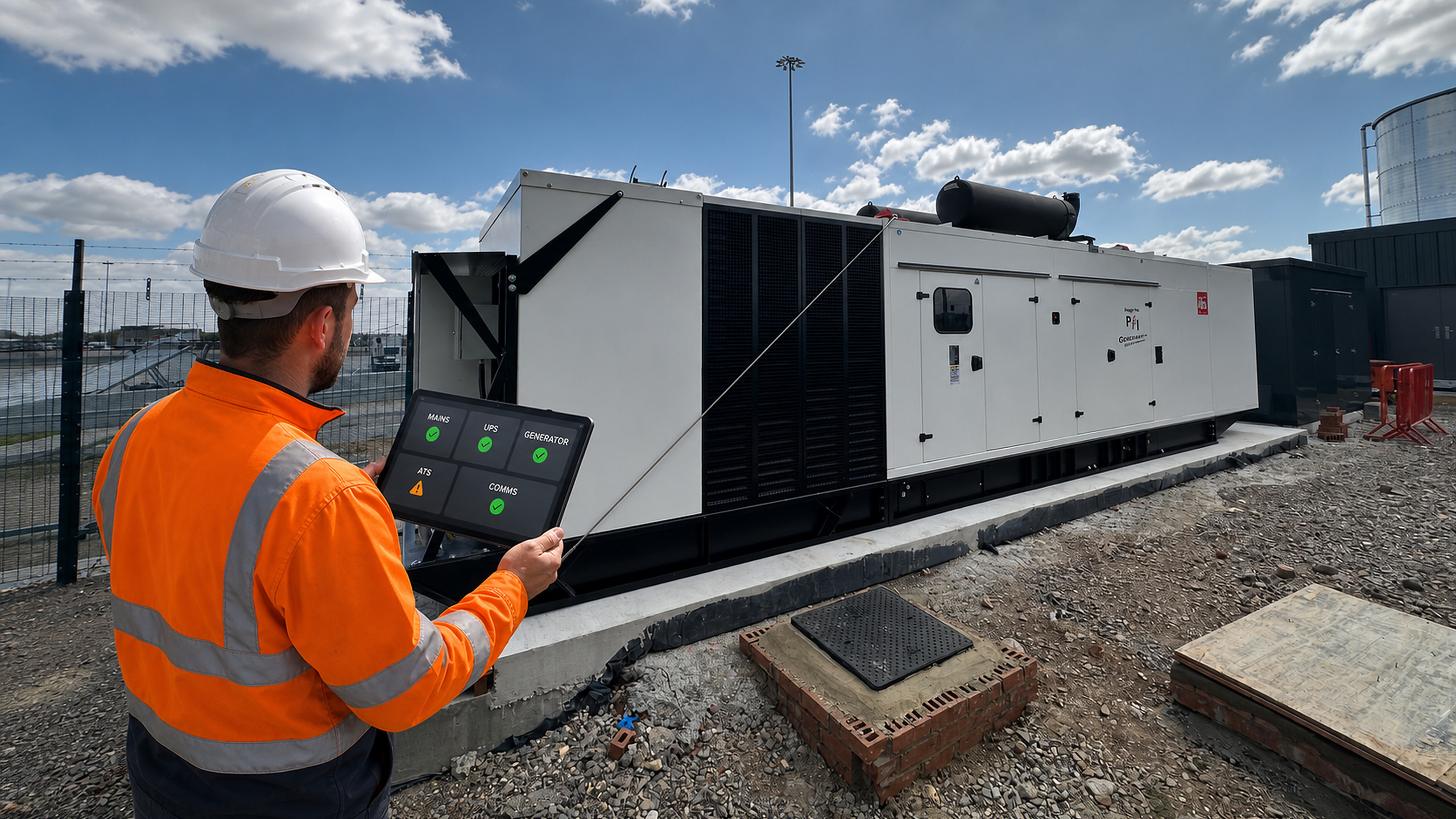
Use monitoring that supports decisions
- mains failure and generator running state
- load kW/kVA and phase currents
- fuel level with useful alarm setpoints
- estimated consumption and hours remaining
- low fuel, fuel-transfer and leak alarms
- supplier contacted, delivery ETA and next decision time
An estimated-hours display is most useful when the underlying fuel and load readings are trustworthy. Manual verification may still be required.
Plan for an extended outage
If the event could outlast the permanent tank and supplier response, identify temporary tanks, generators, connection points and load-shedding stages in advance. Confirm compatible fuel, transfer equipment, permissions and safe operating arrangements.
Review autonomy after every material change
New load, generator replacement, tank work, supplier changes, building access restrictions and revised continuity objectives can invalidate the calculation. Update it with real consumption after tests and outages, and keep the assumptions with the asset record. Frequently asked questions
Divide usable fuel by expected hourly consumption at the planned load, then account for reserve, changing demand and operating constraints.
Usually not. Safe fill, dead stock, pickup level, alarms and reserve can reduce the fuel available to the engine.
It varies by model and load. Use manufacturer data for the exact set and compare it with measured consumption from controlled tests or real events.
Choose a risk-based reserve that covers uncertainty and consequence. Express it in litres and hours at the critical load, with clear escalation thresholds.
Only if supplier capacity, ordering, access, fill points, safe delivery and regional-event demand have been considered and tested.
No. Fuel quality, filters, transfer pumps, batteries, controls, cooling and the electrical load path also affect readiness.
Yes where the UPS will recharge while the generator supports it. Recharge demand and staged restoration should be included in the operating scenario.
After significant load, generator, tank, supplier, access or continuity-plan changes, and when real event data shows the assumptions were inaccurate.
Replace a rough fuel estimate with a tested autonomy plan
Reliable backup hours come from usable fuel, measured demand, an operating reserve and a refuelling route that works under incident conditions.
Contact P&I Group for generator servicing, refuelling, load testing, temporary power and fuel-autonomy planning.
Latest news
What Happens During a Critical Power Site Survey?

16 October 2026
A reliable critical power system starts with understanding the site. Before recommending a generator, UPS,...
Read more...
Temporary Power for Planned Shutdowns: A Site-Readiness Checklist

8 October 2026
A planned electrical shutdown should be easier to manage than an emergency outage. The date...
Read more...
What Signals Should a UPS or Generator Send to a BMS?
2 October 2026
A BMS can show that a generator is running or that a UPS has a...
Read more...
Generator Fuel Autonomy: How Many Hours of Backup Power Does Your Site Need?
25 September 2026
'How many hours will the generator run?' sounds like a simple fuel-tank question. In practice,...
Read more...
How Often Should an Automatic Transfer Switch Be Tested?

18 September 2026
An automatic transfer switch may remain in one position for months, then be expected to...
Read more...
View all