

Latest News
Choose useful UPS and generator BMS signals, from run, alarm and bypass states to fuel, runtime and load, with clear priorities and testing.
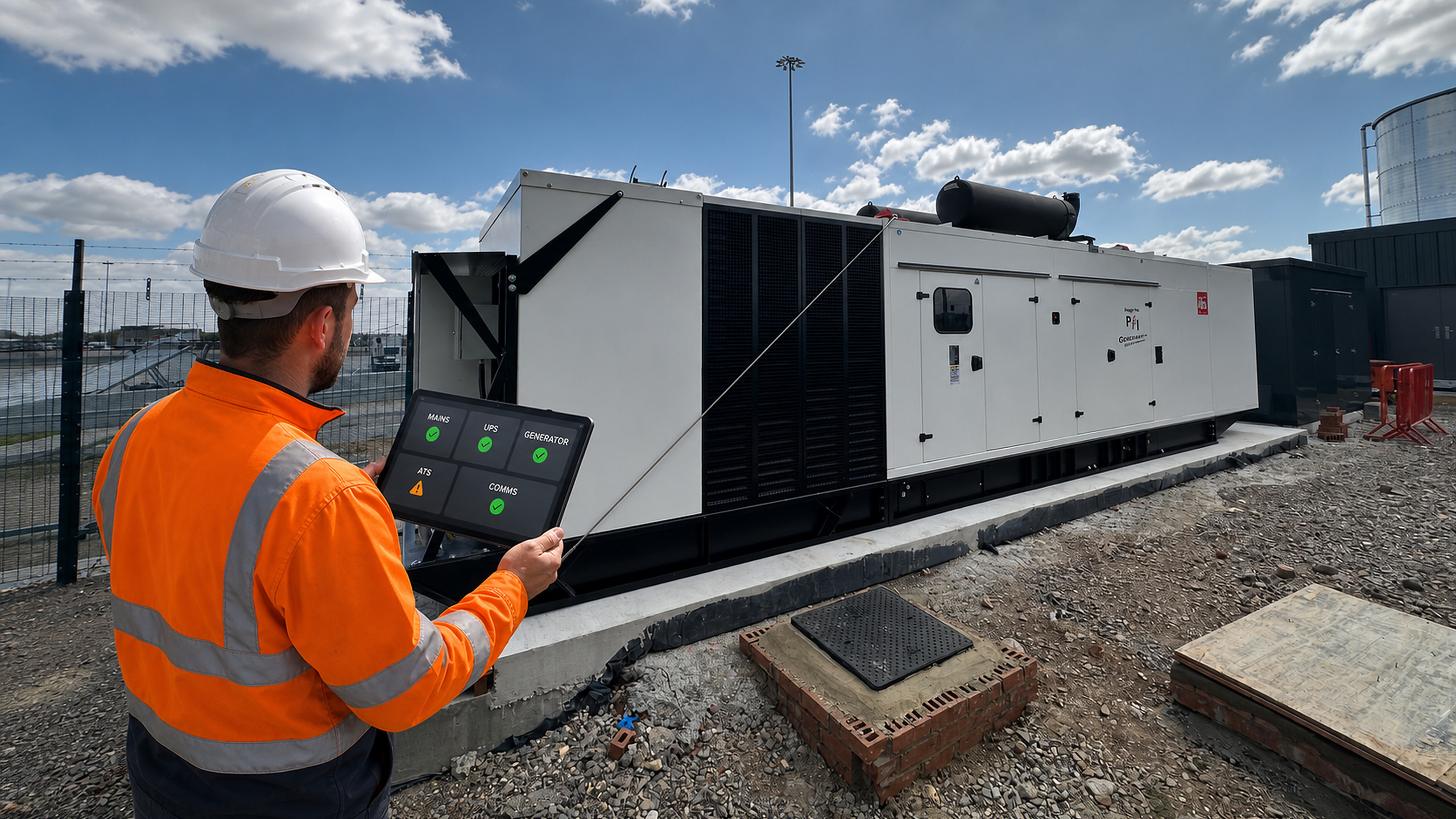
A BMS can show that a generator is running or that a UPS has a common alarm. Those points are useful, but they may not answer the questions an incident team actually has: Is the critical load on backup power? How much runtime remains? Is redundancy degraded? Who needs to respond now?
Good integration starts with operational decisions, then selects signals. It does not begin by importing every available register into one crowded alarm page.
Quick answer: which signals are essential?
At a minimum, the BMS should distinguish normal state, loss of normal supply, equipment running or supporting load, bypass or transfer state, common warning, common shutdown and communications failure. Critical sites normally benefit from selected load, battery-runtime, fuel and temperature measurements as well.
Separate state, alarm and measurement
State
A state describes the current operating position: UPS on inverter, UPS on battery, ATS on generator, generator running or equipment in manual mode.
Alarm
An alarm identifies an abnormal condition requiring attention: low fuel, battery fault, failed start, overload or high temperature.
Measurement
A measurement adds context: load percentage, kW, voltage, frequency, battery charge, runtime estimate, fuel level or temperature.
Keeping these types distinct makes displays clearer and avoids treating a normal operating state—such as generator running during a planned test—as a fault.
Recommended UPS status points
- UPS available/healthy
- normal operation on inverter
- on battery
- on static or maintenance bypass, where available
- battery charging or low battery
- output supplying load
- redundancy lost or module unavailable for modular systems
- remote shutdown active or UPS not in normal auto configuration
Recommended UPS alarms
- common warning and common critical/shutdown alarm
- battery fault or replace-battery condition
- low battery or low runtime
- overload or capacity exceeded
- high temperature or fan fault
- rectifier, inverter or charger fault
- input, bypass or output supply abnormal
- communications failure
The exact alarm map is model-specific. Where the BMS cannot import detailed codes, retain access to the UPS event log and define what the common alarm means operationally.
Useful UPS measurements
- input and output voltage and frequency
- output kW, kVA, current and load percentage
- battery charge percentage and estimated runtime
- battery voltage or string data where supported and appropriate
- internal or battery temperature
- module load and redundancy state
Measurements are valuable when they drive thresholds or trends. Avoid displaying precision that the sensor and protocol do not genuinely support.
Recommended generator status points
- auto mode available
- start command present
- engine running
- generator available at acceptable voltage and frequency
- generator breaker closed or load supplied, where monitored
- mains failure
- ATS normal-source or generator-source position
- cool-down or stopping state where useful
'Generator running' and 'critical load on generator' are different facts. Include breaker or ATS position if the response depends on knowing whether power has actually transferred.
Recommended generator alarms
- failed to start or failed to stop
- common warning and common shutdown
- low fuel and critically low fuel
- low oil pressure and high coolant temperature
- battery or charger fault
- over/under voltage or frequency
- overload or breaker trip
- fuel-transfer or day-tank fault
- not in auto mode
- communications failure
Useful generator measurements
- voltage, frequency and current by phase
- kW, kVA, power factor and load percentage
- engine speed, oil pressure and coolant temperature
- running hours and start count
- fuel level and, where derived reliably, estimated autonomy
- starting-battery voltage and charger state
Do not forget the ATS and distribution
The ATS connects source availability to load supply. Normal source available, emergency source available, switch position, transfer failure, manual mode and common alarm can be as important as the generator points. Critical breakers or downstream distribution may need their own status.
Dry contacts, Modbus or network monitoring?
Dry contacts
Simple relay contacts are robust and easy to understand. They suit a small number of essential states or alarms but provide limited detail. Decide whether the contact is normally open or normally closed and how cable or power failure will be detected.
Modbus
Modbus can expose many states and measurements. The integrator needs the correct register map, data type, scale, byte order, unit address and firmware context. Polling too many unnecessary points can create noise and maintenance burden.
SNMP or vendor network interface
Network interfaces can support richer remote monitoring and notifications. They require ownership, cyber-security controls, time synchronisation, access management and firmware maintenance.
Design communications-loss alarms
A silent equipment point can look healthy if the BMS only alarms on an active value. Use a heartbeat, watchdog or protocol-quality state so loss of data is visible. Define how quickly a missed update becomes an alarm and avoid nuisance events during planned network work.
Prioritise alarms by action
- critical: immediate risk to load, safety or available runtime
- urgent: resilience degraded and engineer response required
- warning: condition needs investigation or planned action
- information: state change or planned test event
Each priority should have a recipient, response expectation and escalation route. A BMS that raises an alarm nobody owns is only an archive.
Test from equipment to person
Commissioning should prove the point at the source, its correct label and state on the BMS, timestamp, priority, notification and response record. Test normal-to-alarm and alarm-to-normal transitions, plus communications loss.
Retest after controller, interface, firmware, BMS or network changes. During generator and UPS maintenance, confirm that planned test events are handled correctly and that equipment returns to normal configuration.
Keep a controlled signal schedule
For every point, record source equipment, protocol address or terminal, name, units, normal state, alarm priority, delay, recipient and response. Include firmware/register-map version where applicable. This schedule is the contract between equipment supplier, controls integrator and operator.
Frequently asked questions
It is a useful minimum but often lacks the detail needed to judge urgency. Battery, bypass, overload, runtime and communications states can make the response more effective.
No single point is enough. Running state, source availability, breaker or ATS position, common shutdown and low fuel together describe whether useful power is available.
Usually not. Select points that support decisions, trends, maintenance and incident response, then control the signal schedule.
Dry contacts provide a small number of simple binary states. Modbus can provide many alarms and measurements but needs correct mapping and communications management.
Use a protocol-quality, watchdog or heartbeat alarm so stale data cannot appear healthy. Define delay and planned-maintenance handling.
Remote control introduces operational and safety risk. Only implement commands within an engineered, authorised control philosophy with interlocks, security and clear ownership.
Classify planned states correctly, use maintenance suppression under controlled procedures and keep critical faults visible. Confirm normal alarming afterwards.
Ownership is shared: the equipment specialist defines available and meaningful points, the BMS integrator maps them, and the operator defines priority and response.
Make monitoring answer the incident team's questions
The strongest signal list is short enough to operate, detailed enough to diagnose and tested all the way from equipment to the responsible person.
Contact P&I Group to review UPS, generator and ATS monitoring, remote alerts and maintenance integration.
Latest news
What Happens During a Critical Power Site Survey?

16 October 2026
A reliable critical power system starts with understanding the site. Before recommending a generator, UPS,...
Read more...
Temporary Power for Planned Shutdowns: A Site-Readiness Checklist

8 October 2026
A planned electrical shutdown should be easier to manage than an emergency outage. The date...
Read more...
What Signals Should a UPS or Generator Send to a BMS?
2 October 2026
A BMS can show that a generator is running or that a UPS has a...
Read more...
Generator Fuel Autonomy: How Many Hours of Backup Power Does Your Site Need?

25 September 2026
'How many hours will the generator run?' sounds like a simple fuel-tank question. In practice,...
Read more...
How Often Should an Automatic Transfer Switch Be Tested?

18 September 2026
An automatic transfer switch may remain in one position for months, then be expected to...
Read more...
View all