

Latest News
Maintenance is part of the deal and you as an owner or operator should understand how to best look after your Uninterruptible Power Supply Solution.

It's no secret that understanding the capabilities of a UPS is tricky. Here at P&I, we believe that everyone should understand the critical power solution they are choosing as well as how to look after it. As with all products, maintenance is part of the deal and you as an owner or operator should understand how to best look after your systems.
In this blog, we are going to guide you through a little more of what you need to know about Uninterruptable Power Supply Solutions. We'll talk about the intricacies relating to the UPS, as well as how to prolong its life span. We will also touch on some frequently asked questions about UPS systems. By the end of this article, you should have a good understanding of which system is best for you and how it should be maintained.
First, let's have a quick summary of what a UPS is, how it works, and the power options available.
What is a UPS?
A UPS is an Uninterruptible Power Supply. It is a device that provides emergency power to a critical load when the input power source fails. You can read our more in-depth blog on what a UPS is here.
How does a UPS work?
A UPS works by continuously providing conditioned power and emergency power to a load when the input power source fails. It does this by using a battery to supply power to the load when the mains input power source is lost. The battery is typically charged by the input power source, and when the power fails, the UPS switches to using the battery to power the load.
What size UPS should I get?
The size of the UPS you need depends on the type and power demand of the load you want to protect. Consideration regarding the power demand of the equipment you need to keep powered and the runtime you need for this for is necessary. UPS power is measured in VA (Volt Ampere, which is the apparent power) and this is calculated by multiplying the voltage used and the current required by the load. This will indicate the minimum kVA value that the UPS will need to meet in order to power the critical load. The size of the battery doesn’t determines the run time i.e. how long the UPS will keep the load powered in an emergency and is an equally important factor in system selection.
What is the best way to prolong the life of my UPS battery?
The best way to prolong the life of your UPS battery is to keep it charged, cool with limited charge and discharge cycles. If storing the battery, all the time it is not in use it will slowly discharge. If the battery is discharged too much (deep discharge) it can permanently damage the battery. Batteries should not be left for more than a 6-month period without a recharge. It is therefore important to keep the battery charged and never let it get into deep discharge. UPS when using the battery have a protection level that will ensure that the battery does not get damaged by dropping below a set limit, this prevents deep discharge. Keeping the battery in a controlled temperature is vital to ensuring a longer life, VRLA batteries are designed to operate in an ambient temperature of 20°C, higher temperatures reduce the lifespan (a 10°C rise in temperature can half the lifespan of the battery). UPS batteries only have a limited number of discharge and recharge cycles, so the more they are used the less the shorter the life expectancy.
What’s the difference between battery design life and battery service life?
The design life of is based on the battery being used in optimum (often laboratory) conditions and the service life is the typical time a battery might remain operational with reasonable use before replacement is needed. The life spans for a standard VRLA battery is typically a 5 year design life, which is a 3 year service life, so this means you might expect to get between 3 to 5 years of use, depending on how it is used and the environment it is in. Longer life batteries can have a design life of 10 -12 years or even up to 20 years, but the real service life will always be shorter than this.
How often should I maintain my UPS?
It is recommended that a UPS and battery in a clean environment is maintained at least annually, this can however be every 6 or even 3 months if the environment requires it. A maintenance involves a visual inspection and check of the integrity of all electrical components, cables and connections followed by cleaning out the UPS. Dust in a UPS can become a serious hazard, industrial dust in layers of only 3mm can become highly explosive! Electrical measurements are made, critical updates applied and correct system operation verified. A battery inspection is also important, including the integrity of each battery block, making sure all the cables and connections are secure along with analysis testing for the internal resistance values of the cells to determine their condition. A good maintenance regime will ensure the functionality and safety of the entire system. The maintenance of a UPS should be carried out by qualified and competent UPS engineers. Remember HSE has provided the industry with responsibilities for manufacturers, suppliers and end-users on the proper maintenance of a UPS.
Would connecting a UPS to another UPS work?
Yes, you can connect a UPS to another UPS providing they are both capable of parallel operation. This is done by connecting two or more UPS together that all communicate with each other so that they can share the load equally on their outputs. For critical loads this is the best way to increase the resilience of the UPS system and add redundancy by removing any single point of failure as full protection with no risk can be achieved even while the UPS are being maintained. It is often wrongly believed that connecting the input of one UPS to the output of another UPS (to cascade or daisy chain them together) will increase redundancy. This should never be done as it can cause many issues, it does not increase the redundancy as might be expected but does in fact have the opposite effect as it can increase the risk of UPS failure.
Which one is better, Line interactive UPS or Online UPS?
This depends on your needs. If you need a small cost-effective and efficient UPS that will provide some basic power protection and battery back up in the event of a mains failure (where the load can withstand an outage of milli seconds) then a line interactive UPS is a good choice. If, however you need a UPS that can provide clean and consistent power with no delay in the event of a mains fail then an online double conversion UPS gives the best protection available today. Line interactive UPS typically provide power for smaller loads often less than 10kVA (10,000VA) while double online conversion UPS can power loads right up to MVA (1,000,000VA)
So there you have it, a quick and easy guide to choosing the right UPS and maintenance solutions. We hope you found this blog helpful. If you have any further questions, please contact us.
P&I provides you with various critical power solutions. From project management, to hire solutions, as well as UPS and Backup Generators. No matter your power needs, our team are on hand to help.
Latest news
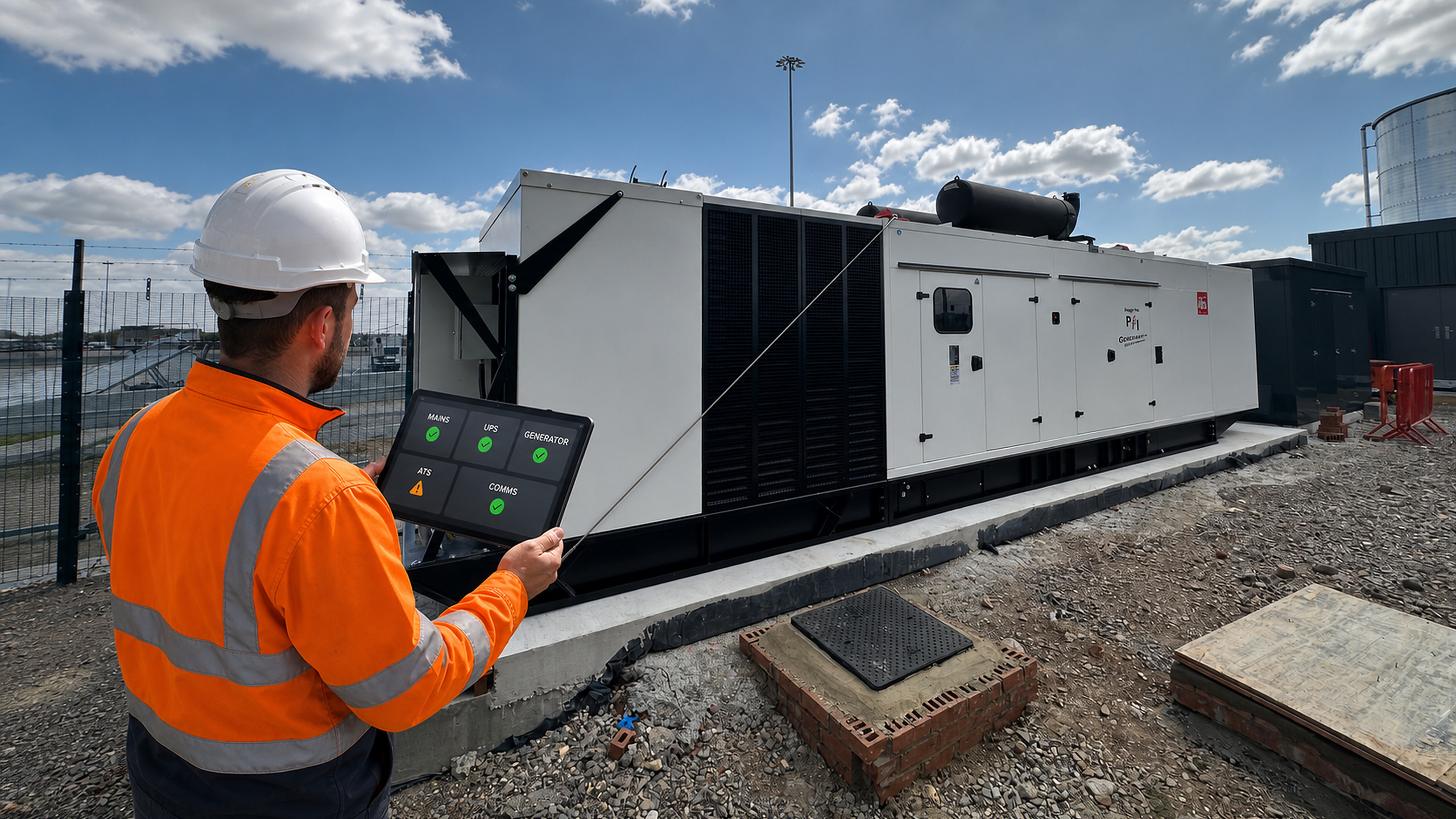
What Signals Should a UPS or Generator Send to a BMS?
2 October 2026
A BMS can show that a generator is running or that a UPS has a...
Read more...
Generator Fuel Autonomy: How Many Hours of Backup Power Does Your Site Need?

25 September 2026
'How many hours will the generator run?' sounds like a simple fuel-tank question. In practice,...
Read more...
How Often Should an Automatic Transfer Switch Be Tested?

18 September 2026
An automatic transfer switch may remain in one position for months, then be expected to...
Read more...
UPS Fan Fault: Causes, Risks and Safe Next Steps

11 September 2026
Fans remove heat from power electronics, filters, transformers and other UPS components. If a fan...
Read more...
Backup Power for Wastewater Pumping Stations During Peak Wet Weather

1 September 2026
A power failure at a wastewater pumping station is difficult at any time. During prolonged...
Read more...
View all